
Statements on painting and studio practice
Edited remarks from The State of Things gallery talk, at the Crary Art Gallery, Warren, Pennsylvania

Zig Zag III, oil on linen, 24x30”, 2025
When I’m painting, no matter the subject, I’m trying to satisfy two needs: to make formally solid paintings and to create meaningful content. I constantly worry that these goals might be mutually exclusive, and that reconciling them may be beyond my grasp, and therefore I feel conflicted about these paintings.
I’ve been painting still lifes almost exclusively for the past seven years. If you ask me why, I don’t have an easy answer. During my career, I’ve oscillated between two different strains of painting practice: working from directly-observed subjects such as interior spaces, landscape, and still life; or creating non-observational figure paintings, which I’ll call narratives, that examine the human condition. As much as I’d like to, I don’t really control the timing of when I work from observation and when I paint from my head. Each time the pendulum has swung from one type of work to the other it’s been the result of a sort of artistic reckoning, and the transition is always a struggle. Both types of work are included in this show and, together, may represent the pendulum, mid-swing.
I paint figure-based narratives to communicate something I am feeling, or when I am working through a perceived problem. These periods often coincide with a temporary loss of faith in observation-based painting. I switch to observation when narratives no longer feel like a valid way to express my concerns. Working from observation is also restorative: observing forms, space, light, and color helps to inform the paintings that I’ll create later from imagination.
Ideally, I want still life to communicate like narrative and convey how I feel about the world. In this regard, I feel as though these still lifes are too tasteful and not ugly enough. What I keep finding, despite my intentions, is that the act of observing and depicting light and shadow and objects in space becomes more intriguing than the attempt to create something ugly, and ends up draining the intended pathos. The act of painting keeps becoming an escape from the dread or despair that I’m trying to communicate, and form keeps supplanting content.
Most of these still lifes are an attempt to suggest a story. I started with the Balancing Act paintings, by precariously stacking objects. Their imbalance appealed to me as an allusion to societal unrest and spoke to my increasing discomfort with the still life genre. A second idea, explored in the Schism paintings, was to arrange the still lifes to look as though they were splitting apart. I did this by using a fabric as a physical barrier that cuts through the composition, with groupings of objects on either side. While this arrangement interested me as an unconventional composition, it surprisingly suggested that the object groupings on either side of the divide might be oppositional. The Zig Zag studies that followed are a variation on these ideas. Here, the physical fabric barrier was replaced by a new type of division created by differences of color. In each Zig Zag painting I set up contrasting colored fabrics which meet along a zig-zagging edge that roughly bisects each canvas into distinct color zones. The objects within each zone were selected to further suggest a clear separation between the sides.
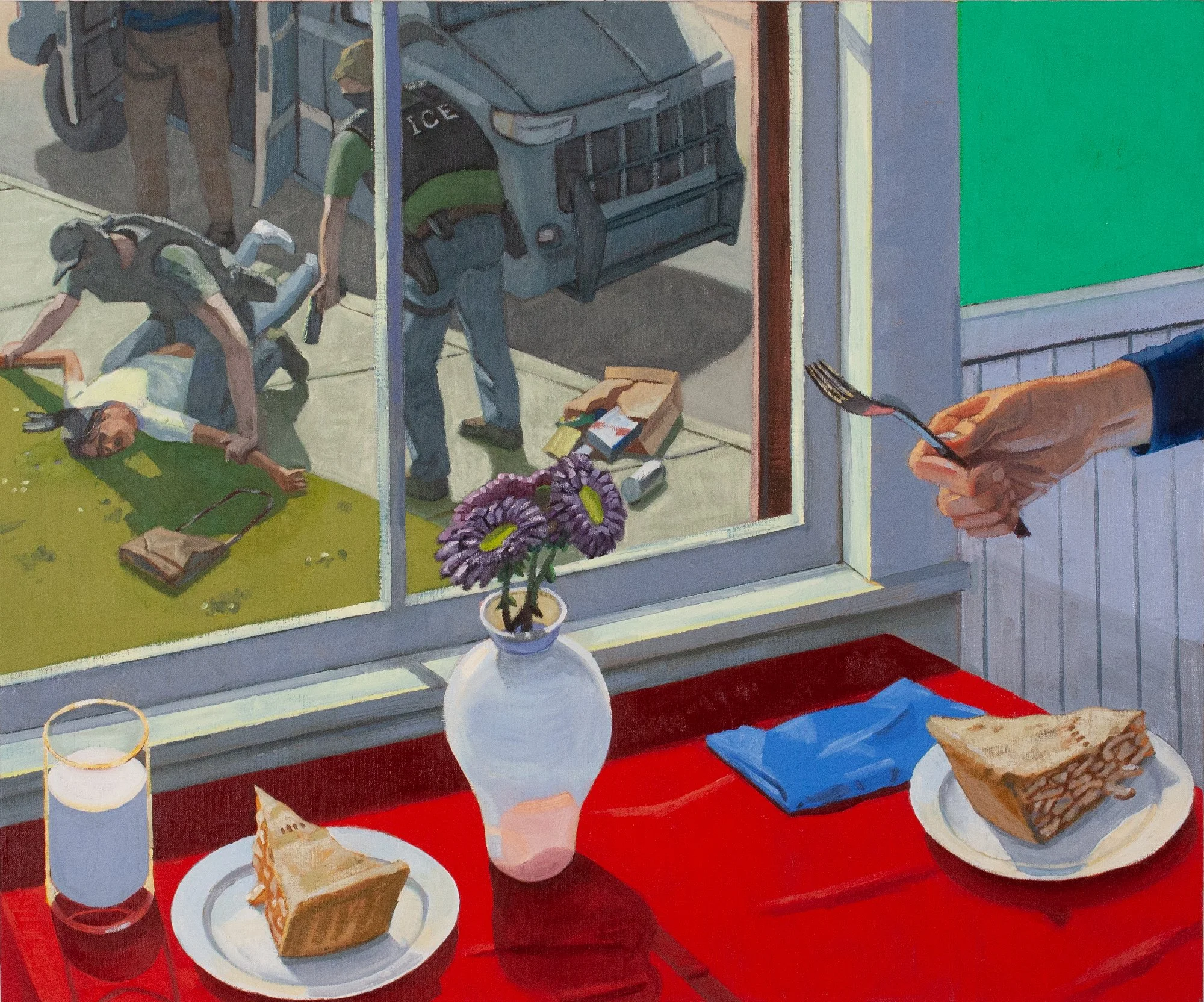
Apple Pie, oil on linen, 30x36”, 2025
In the chronological middle of this body of work are two seemingly incongruous paintings, Apple Pie and Male Engagement. These paintings were created after short trips disrupted my studio momentum and my tenuous sense of purpose. They are non-observational and they represent a conscious attempt to swing the pendulum towards narrative, as well as my conscience urging me to comment more overtly about the present national condition. In the case of Apple Pie, I was intrigued by the concept of combining a symbolic still life with a political commentary. I simultaneously consider this painting a retort to still life painting. Each image depicts interior and exterior spaces and suggests a divide, in which each world is possibly oblivious of the other. In this sense, these non-observational paintings and the some of the still lifes seem to reflect similar concerns.
- 6 June, 2026

Abyss, oil on linen, 24x20”, 2024
For the past five years I’ve been painting still lifes and studio scenes from direct observation. In each scenario I look for something visually challenging to paint and impose some formal or technical parameter to work within. What happens if I combine these colors, or arrange my palette with this grouping of pigments? What if this object touches the edge of the picture plane? How can I effectively depict this surface or fabric? On a conceptual level, is it possible to imbue the image with a semblance of meaning? Some of the forms I paint have personal significance while other objects are chosen for purely formal reasons, or for the technical challenge of painting them.
In each painting I attempt to create an unromanticized yet compelling arrangement that doesn’t feel traditional and staid, which is how I assume most people consider the genre of still life, if they consider the genre at all. In most cases I try to avoid harmonious or familiar color arrangements to, instead, find color combinations that are intentionally discomforting. By using quirky objects as subject matter, or by combining them with more traditional objects, I seek to create scenarios and images that feel somewhat unsettled. In many cases, the manner in which I arrange and frame the forms is intended to create spatial and compositional tension. I suspect that, despite my stated intentions, my love of paint makes it difficult for me not to aestheticize the paintings through the depiction of light or displays of proficiency, and that this makes them less dissonant than what I had hoped for.
Still life is a genre that I’ve strayed from and returned to multiple times during my four-plus decades of painting. I’ve always felt somewhat conflicted about painting this subject due to its (possibly undeserved) bourgeois connotations. The fact is, depicting light and forms in a manipulated space has been a lifelong concern that connects this body of work to my other on-again off-again genre of choice, figurative narratives. Just as my figure-based images might offer a direct insight into my world view, my hope is that the manner in which I depict objects on a tabletop could also, perhaps less directly, communicate something about how I see the world. My most fundamental purpose, however, is that these paintings offer enough complexity for engaged contemplation, and that the formal aspects of the images hold up and keep revealing themselves under repeated scrutiny.
- December 2024

My paintings are created primarily in oil paint and my drawings in charcoal and graphite. They are largely informed by the direct observation of my subjects and surroundings, although I additionally create narrative images that combine aspects of direct observation with memory and imagined scenarios.
While my images are representational, I am not primarily concerned with the attainment of realism as a goal in itself. I consider myself a formalist in artistic temperament, and I am primarily interested in perceptual issues. Among these are the subtle and constantly changing relationships among colors. I am fascinated by the manner in which composition, color, and paint application combine to affect the manner in which form, volume, light, and space are depicted within the picture plane. The degree to which individual works appear realistic, expressionistic, or abstracted varies, depending on my response to the forms I observe, and what I am trying to convey. I attempt to capture the dynamic tensions or contradictions in spaces and forms, which largely reflects the manner in which I perceive and experience my visual surroundings.
In my figurative paintings and, to a lesser degree, in the still lifes I arrange, I attempt to infuse the image with some existential question or conundrum. However, I prefer the suggestion of content to something more obvious or literal. It’s difficult for artists to strike an effective balance, so that pictorial content (symbolic, metaphoric, or narrative) is neither obvious or (worse, even) convoluted and esoteric. In any case, I typically find that enigmatic images have a greater capacity to feel compelling and universal, and I seek that quality in the images I construct.
- August, 2015
My painting process is something of a confessional act. I use painting to examine things that scare me, or situations whose solution eludes me. To intellectualize this process as an explanation for why I paint my particular subjects is possibly disingenuous, and suggests a level of lucidity that may be over-appraised. However, a certain amount of emotional distancing is necessary for me to face the images as they emerge and are realized on canvas, some of it requiring rational thought. I occasionally question just how rational or good this distance is for my work, but it's how I get the paintings done. Love and relationships, and my ambivalence about them, are the impetus behind many of these metaphoric narratives.

Give and Take, oil on canvas, 64x48”, 2000
Most of the paintings have a sordid, ‘dirty laundry’ sensibility about them. This aesthetic has a perverse appeal for me, and provides a formal and creative challenge. I'm interested in the problem of presenting an uncomfortable situation or disorder so that it retains its unsavory character, yet compels viewers to look and identify with it on some personal level.
The more recent paintings, completed during the last two to three years, are a further search for balance between formal and pictorial concerns that has driven my work for a long time. Compared to earlier paintings, where I indulged my interest in deconstructing form and space with a different regard for the narrative, my recent approach to form has become more restrained or controlled. For a painter, meaning is achieved or modified as much- if not more- by the manner in which color, paint, space and form are manipulated as the subject that is presented. I currently equate the role of the formal elements in a painting to that of a piano accompanist in a vocal recital: to provide a sympathetic platform for the soloist. The narrative may get more attention as the so-called subject of the painting, but the manner in which the narrative has been presented ultimately determines the integrity or character of the work.
I want the formal aspects of these works to be demanding and accomplished, but not conspicuous. In essence, I want form to create an atmosphere that allows the viewer to enter, consider, and search for meaning in the narrative.
- February, 2004
2021 © Terry McKelvey